
The Lost Art of Channel Surfing
Some wastes of time are better than others

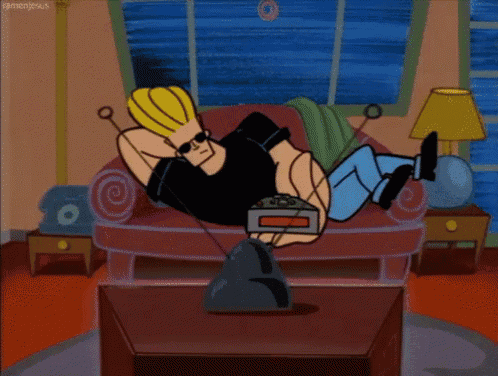
Before the video revolution of YouTube, before TikTok, before Instagram, before Netflix and HBO and Prime and Hulu and whatever the latest slop-peddling-streaming-service is popular right now, there was The Television. No, not the streaming kind, the real kind. And before browsing, swiping, tapping, streaming, and doomscrolling, there was Channel Surfing.
And it was beautiful.
The Television wasn’t smart. It didn’t have WiFi connectivity and an entire ecosystem of streaming apps and voice search, hell, it didn’t even have pause and rewind. Even as a physical object it wasn’t slick and it wasn’t sexy; in fact it was a dumb, fat little box that sat in your living room and whose remote you always kept losing because you buried it five feet deep into the crevices of your couch every time you decided to sprawl down on it, ready to munch on a bag of chips.
But nonetheless The Television commanded attention because it was a portal to worlds unseen.
I was reminded of its now-depreciated value when I found myself (inexplicably) watching some cable TV recently. In less than an hour I watched Judge Joe Brown decide on an iPod ownership case, the diner scene from Harry Potter and the Deathly Hallows Part 1, parts of a documentary on Tutankhamun, some Japanese reality show where contestants kept getting thrown into the water in increasingly violent ways, the deciding question of a Jeopardy! round, a tennis match from a sports anime, Gordon Ramsey yelling at a chef, a Family Guy cutaway gag, and footage of a high-stakes poker game.
And it was beautiful.
I was instantly taken back to my early childhood, to the years way before social media, before the internet, and even before we had a desktop computer in our house, back when the only source of entertainment for me was the TV and when channel surfing was my favourite indoor hobby. I’d spend hours in front of that screen sampling various lives. I’d watch bits of a CID episode, John Cena pummeling someone on WWE Raw, Gregory House limping while spouting medical jargon I didn’t understand (it wasn’t lupus), people skipping stones on Takeshi’s Castle, Rosesh from Sarabhai vs Sarabhai yelling at his mom, Sehwag getting bowled out at 0, Vegeta punching the crap out of an alien, a ranking of the ten best cats on Animal Planet’s Most Xtreme, a scene from the movie Welcome (which was somehow always playing), and the three hilarious guys from Top Gear driving cars I knew I’d never drive and going somewhere beautiful I knew I’d never go. (But hey, at least the TV allowed me to accompany them vicariously.)
The beauty of channel surfing was that it led you to stumble upon things that were vaguely interesting, but that you would never have explicitly sought out on your own. There was an inbuilt unknowability there, a fuzzy randomness, that the internet has now obviated out by tailoring content to best fit your interests on whatever platform you’re on. But you never quite knew what you were going to get when you pressed next on that TV remote. A huge part of the charm, in fact, was walking into a show or movie you’d never heard of halfway through, trying to piece where the story was at based on context clues, and still having a great time. This “stumbling upon” things by chance is largely becoming a relic in the digital world. (I suspect a major reason that bookstores are still popular is they physically allow you to do this in some sense.)
And I wasn’t even looking for something in particular every time I switched channels on the TV, nor did I really expect to find something worth watching. The process was the point. Keep changing the channel. Don’t focus. Move on.
Move on. That was the whole game. A little bit of this, a little bit of that. Watch a few minutes of someone skiing at the Winter Olympics, switch to Kramer barging through Jerry’s door, switch to a psychedelic music video, switch to a guy trying to sell an antique at a pawn shop, switch to Jack Nicholson cursing on The Departed (“Don’t laugh! This ain’t reality TV!” LMAO), switch to David Attenborough calmly talking about the mating patterns of an obscure insect in a South American forest. Next, next, next. Oh wait, that looked interesting, go back. Alright, I’ve seen enough, next. It was a state of almost trance-like peace and satisfaction, of letting a weekend afternoon lazily go by, of letting your imagination run wild by sampling tastes from the infinite ether of possibility.
I’m not going to pretend that watching TV for hours like this wasn’t a huge waste of time, or that it was somehow healthier than scrolling social media. But it was somehow healthier than scrolling social media. It was brainrot-adjacent but it added less “rot” to your brain. It was pre-smartphone, pre-memes, pre-vertical-short-form video, pre-slop, pre-everything. It was rough around the edges, it wasn’t modern in that uniform standardized way everything now is.
Of course, every program on “the telly” was produced with the explicit purpose of profiting off of your attention and was designed to hook you in, but that hook felt less insidious, less targeted than it does with stuff online. The Television didn’t have a profile on you. It didn’t track your personal preferences. It just gave you a glimpses into different dimensions of reality regardless of who you were; flashes before your eyes. In a world where any digital content you consume is probably the output of hyper-personalized algorithms that get to decide what you see and read and hear (i.e. your new overlords), and will likely do so for the rest of your life, there’s something to be said about an object that just added some colorful entropy into your life without once wanting to know anything about you, and how rare that’s now become.
This hits home. Some of the best movies /gems that I've discovered were by the TV.
It would sit with me as I had time to process and discuss with someone.
With the short form content, it's mostly what is trending in the past month or what the lords at netflix want to promote.
Time to make the machines dumb again
very good. I would still like to know how bookstores relate to the old dumb TVs, I seem to be missing the connect there.
I do miss the TV only era, it was very peaceful and did not feel like wasting time maybe because it did not actually waste time.